ARoS Aarhus Art Museum: The Ultimate Visitor Guide
Plan your visit to ARoS Aarhus Art Museum with our guide to the Rainbow Panorama, James Turrell's Skyspace, ticket prices, and expert tips for art lovers.
On this page
ARoS Aarhus Art Museum: The Ultimate Visitor Guide
ARoS Art Museum stands as one of the largest and most-visited art institutions in all of Scandinavia. More than 600,000 people pass through its doors every year, drawn by iconic permanent installations, a collection of over 8,000 works, and an architectural concept unlike anything else in Northern Europe. Whether you are deciding is Aarhus worth visiting or already have your flights booked, this museum almost certainly belongs at the top of your list.
The building spans ten floors and is structured around the concept of Dante's Divine Comedy — the dark subterranean levels represent the underworld, the middle floors depict earthly life, and the luminous rooftop walkway evokes heaven. That vertical journey is not just a design metaphor; it shapes how you physically experience the collection as you move through it.
Must-See ARoS Highlights: Your Rainbow Panorama and "Boy"
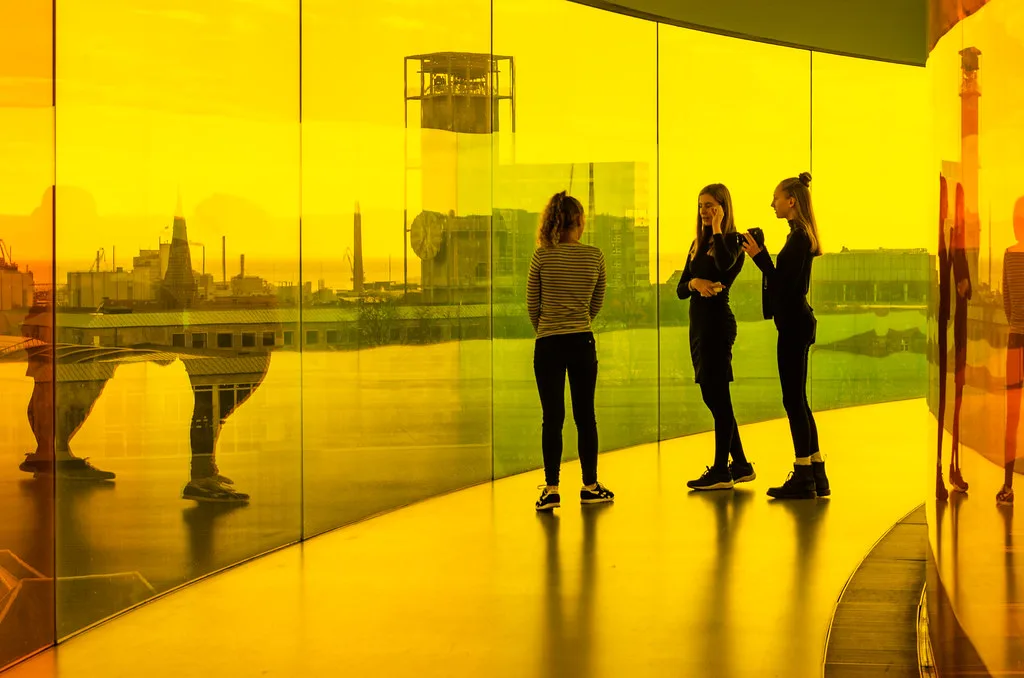
Your Rainbow Panorama by Olafur Eliasson sits on the rooftop and wraps the building in a complete 360-degree circle of colored glass. Installed in 2011, the walkway filters the Aarhus skyline through twelve spectral hues as you walk its circumference. It is permanently open to ticketholders and is the single image most associated with the museum worldwide. Allow at least 20 minutes here — people tend to slow right down and linger.
One floor below the rooftop, Ron Mueck's "Boy" (1999) commands an entire room. The hyper-realistic sculpture stands five meters tall and reproduces every detail of a crouching child with unsettling precision. Scale is the work's whole point: at that size, a figure associated with innocence becomes something physically overwhelming. Most first-time visitors stop and stare for longer than they expect.
These two works anchor the museum experience at opposite ends of the emotional spectrum. Eliasson's piece is expansive and joyful; Mueck's is intimate and quietly confronting. Seeing both in one visit gives you a fair sense of the ambition that runs through the entire collection.
Ticket Prices and Practical Logistics
ARoS is located at Aros Allé 2, 8000 Aarhus C, a ten-minute walk from Aarhus Central Station. For getting around Aarhus, public transit options are excellent. The museum is closed on Mondays, except during June, July, and August when it opens seven days a week. Tuesday through Friday it is open from 10:00 to 21:00; Saturday and Sunday from 10:00 to 17:00. Wednesday late opening (until 21:00) is a good option if you want a quieter experience mid-week.
Current 2026 ticket prices are 190 DKK for adults and 150 DKK for students and young people under 31. Entry is free for everyone under 18. If you hold an AarhusCard, admission is included along with unlimited public transport across the city — worth calculating against the standard ticket price for any visit longer than a day. Buy tickets online in advance through the ARoS website to skip the queue, especially in summer.
Parking is available directly on Aros Allé, where the museum has 79 dedicated spaces. Accessibility is good: a lift leads up to the entrance beneath the main staircase, and all gallery floors including the Rainbow Panorama are reachable by lift. Wheelchairs are available on loan at the information desk at no charge.
- Adult ticket: 190 DKK
- Students / under 31: 150 DKK
- Under 18: free
- AarhusCard holders: free entry included
- Opening hours: Tue–Fri 10:00–21:00, Sat–Sun 10:00–17:00, Mon closed (open daily Jun–Aug)
- Address: Aros Allé 2, 8000 Aarhus C
| Visitor Type | 2026 Price | Best For |
|---|---|---|
| Adult | 190 DKK | Standard visitor |
| Student / Under 31 | 150 DKK | Students with valid ID |
| Under 18 | Free | All children and teens |
| AarhusCard Holder | Free (card cost: 220/day, 560/72hrs) | Multi-attraction visitors + public transit |
The Permanent Collection vs. Rotating Exhibitions
Understanding what stays and what changes helps you plan your time. The permanent collection spans works from 1770 to the present, with particular strength in Danish Golden Age painting, post-war European art, and large-scale international contemporary pieces. Your Rainbow Panorama, "Boy," the 9 Spaces installation floor, and several other signature works are always on view regardless of when you visit.
Rotating exhibitions occupy a separate set of galleries and turn over six to eight times per year. ARoS has brought in major solo shows for artists including Claude Monet, Edvard Munch, Salvador Dalí, Barbara Kruger, Jenny Holzer, Bill Viola, and Sarah Sze. These shows typically run for three to four months and almost always include a broader programme of lectures, debates, and events tied to the theme.
If a specific exhibition is a key reason for your visit, check the ARoS official programme before booking travel. The permanent collection alone justifies a full visit, but timing around a major show lets you see the building at its most programmatically alive. Some touring exhibitions offer English-language guided tours on selected afternoons — check the schedule page for confirmed dates.
The 9 Spaces and Cutting-Edge Installation Art
Level 0 — the lowest floor — houses the 9 Spaces, a dedicated gallery for installation and video art. Nine darkened rooms are each engineered for a single work: blackout conditions, controlled acoustics, and purpose-built projection systems. The effect is total immersion. Some rooms ask you to stand; others invite you to sit on the floor for ten minutes while a video cycle plays out.
Artists represented across the permanent installation programme include Pipilotti Rist, Tony Oursler, Mona Hatoum, Gilbert & George, and Annika von Hausswolff alongside rotating commissions. The 9 Spaces feel categorically different from the gallery floors above — quieter, slower, and more demanding of your attention. They are worth building specific time into your visit rather than treating as an afterthought on the way out.
This section connects the museum's contemporary identity to a longer tradition of immersive art-making. It also makes ARoS meaningful as a destination for visitors who find traditional white-cube galleries uninviting. Exploring these Aarhus attractions in full shows how the museum has built its identity around experience rather than passive viewing.
The Dome: A Skyspace by James Turrell — Opening 19 June 2026
The most significant addition to ARoS in a generation opens on 19 June 2026. "As Seen Below — The Dome, a Skyspace by James Turrell" is a monumental underground chamber located beneath the museum's front square. A circular oculus in the ceiling frames a disc of sky, and Turrell's signature LED lighting system gradually shifts the perceived colour of the opening from blue to violet to amber over the course of a programmed cycle.
At 40 metres wide, this will be Turrell's largest Skyspace built in a museum context anywhere in the world. Unlike a painting or sculpture, the work requires you to stay still and let your perception recalibrate — the sky does not literally change colour, but your brain, exposed to the peripheral light field, begins to perceive it that way. Plan for at least 30 minutes inside the chamber to experience a full cycle.
The Dome is part of the broader "Next Level" expansion that also adds underground gallery space for large-scale work that could not previously be accommodated in the existing building. For visitors arriving from June 2026 onwards, this installation alone cements ARoS's position among the world's leading museums for light and installation art. See the full Turrell Skyspace project details for ticketing updates as the opening date approaches.
Photography Guide: Getting the Best Shots at ARoS
Photography is permitted throughout the permanent collection, including on the Rainbow Panorama walkway, and phones and cameras are welcome. The key restriction is flash — it is not allowed anywhere in the galleries, and tripods require advance permission. Most visiting photographers manage well in natural light, particularly on the upper floors which benefit from large windows and bright Scandinavian daylight.

For the Rainbow Panorama, visit approximately 30 minutes before sunset. As the city lights begin to switch on below, the contrast between the warm urban glow and the coloured glass intensifies dramatically. The east-facing section of the walkway gives the cleanest sightlines across Aarhus's roofscape without the western sun causing lens flare. Step close to the glass and shoot at a slight downward angle to eliminate the walkway railing from the frame.
The 9 Spaces galleries are dark by design and the light levels shift during each work's cycle. Wait for a stable point in the cycle before shooting — video installations in particular have intervals of higher brightness that make handheld photography viable without raising ISO excessively. For "Boy," position yourself at floor level and shoot upward to emphasise the scale differential that makes the piece so effective.
Family-Friendly Tips and the Free Third Floor
Entry is free for everyone under 18, making ARoS one of the most accessible major museums in Denmark for families. The museum offers dedicated creative workshops where children can make their own work using provided materials. Interactive displays on several floors keep younger visitors engaged between the bigger set pieces. Wide lifts, stroller-friendly ramps, and disabled toilets on levels 3, 4, 8, and 9 make practical navigation straightforward.
Level 3 is a free social space open to everyone without a ticket. The lounge area and museum shop can be accessed here, making it a useful meeting point or a place to rest mid-visit without committing to the full gallery circuit. Students and local residents use it as a workspace and casual hangout. It is also where the seasonal creative workshops for non-ticketed visitors often take place.
Budget-conscious travelers should check the AarhusCard before buying individual tickets. The card covers ARoS entry plus unlimited bus and light rail travel across the Aarhus metropolitan area — if you plan to visit more than one or two paid attractions, it typically pays for itself within a day. See the things to do in Aarhus guide for a full breakdown of what the card covers.
Dining, Shopping, and the ARoS Café
The ARoS Café and Orangery is the main food option inside the museum, serving coffee, pastries, open-faced sandwiches, and light meals. The Orangery section has outdoor seating during summer months. It is a relaxed space that works well for a mid-visit break or a simple lunch. The quality is above the typical museum café standard and the pricing is reasonable by Danish standards.
For a more formal meal, the ARoS Wine & Food restaurant on the top floor offers a Nordic menu built around seasonal Danish produce. Views across the city are a genuine feature rather than a gimmick. Booking in advance is recommended for dinner, particularly on weekends. It can turn a museum visit into a full evening if you coordinate it with the Wednesday late opening.
The ARoS Store on Level 3 carries Scandinavian design objects, jewellery, art books, and exhibition catalogues. A portion of the range is museum-exclusive. The shop is accessible without a ticket, so it is possible to browse independently of a gallery visit. For art book collectors, the selection here is genuinely strong and covers many of the artists represented in the permanent collection.
Current Exhibitions and Planning Your Visit
ARoS presents six to eight major international exhibitions per year, many of them large-scale solo shows or thematic surveys that travel to or from partner institutions. The programming tends to mix historical retrospectives with living contemporary artists, keeping the calendar varied across the calendar year. Each exhibition typically has an accompanying events programme: talks, guided tours, evening openings, and educational sessions.
To see what is currently showing, consult the ARoS official programme before you travel. The website lists all exhibitions with dates, guided tour schedules, and any special admission requirements. English-language tours are available for most major shows, usually on specific afternoon slots — times are published on the exhibitions page.
Allow three to four hours for a thorough visit covering both the permanent collection and a current exhibition. If you want to include lunch at the café and time in the Dome (from June 2026), a full day is realistic. Start at Level 0 with the 9 Spaces while you are fresh, work upward through the collection, and finish on the rooftop with the Rainbow Panorama at the light-optimal time for photography. That sequence uses the building's architecture the way it was designed to be experienced.
Frequently Asked Questions
What is the best time to visit the Rainbow Panorama?
The best time to visit is during the "Golden Hour," roughly 30 minutes before sunset. This timing allows you to see the city lights begin to glow through the colored glass. Weekday mornings are also excellent for avoiding large crowds and taking clear photos.
How much are tickets for the ARoS Art Museum?
Adult tickets are approximately 175 DKK, while students with ID pay 145 DKK. Entry is free for everyone under the age of 18. If you have an AarhusCard, your admission is fully covered. For more details, check our guide to things to do in Aarhus.
Is the ARoS museum suitable for children?
Yes, the museum is very family-friendly with interactive exhibits and creative workshops. The large "Boy" sculpture and the Rainbow Panorama are usually big hits with kids. The facility also offers strollers and easy elevator access for parents.
How long does it take to walk through ARoS?
Most visitors spend between three and four hours exploring the ten floors of galleries. This allows enough time to see the permanent collection and any special rotating exhibitions. If you plan to dine at the museum restaurant, allow for an extra hour.
ARoS Art Museum is more than just a gallery; it is a landmark of Danish creativity. From the heights of the rainbow to the depths of the 9 Spaces, it offers endless inspiration. Every traveler should make time to experience this architectural and artistic marvel. For the bigger picture, see our complete things to do in Aarhus guide. See also our Aarhus Cathedral Guide and Den Gamle By Aarhus guides. For more travel inspiration, read more on the Denmark Wander blog today.
You might also like


Continue reading
More guides you'll find useful